Cookies play a big role in how websites track performance, understand user behaviour and run digital marketing activity.
They help tools like Google Analytics and Google Ads work properly, but they also rely on users giving clear consent.
Your cookie banner is not just a small pop-up people click past. It is a key part of how your website collects consent, protects user choice and keeps your tracking setup working as it should.
Research suggests the way these banners are designed can have a real impact on what users choose to do.
So, what actually makes someone accept or reject cookies?
Effort really changes behaviour
Research found that when rejecting optional cookies took more effort, people were more likely to accept them.
In one experiment, users were shown different cookie banner designs. The privacy-friendly version made it easier to choose necessary cookies only, and users accepted fewer cookie categories.
Where rejecting optional cookies was less straightforward, users accepted more.
This does not mean businesses should make rejection harder. It shows how much influence the consent journey itself can have. Cookie banners need to be designed carefully, so users can make a clear and informed choice.
Highlighted buttons affect what people click
Research also found that visual emphasis changed behaviour.
That is a small design detail with a measurable impact.
Button colour, contrast, placement and emphasis are not just visual decisions. They can affect how users interact with consent options.
When the accept button is highlighted, people are more likely to accept cookies. When the reject button is highlighted, acceptance drops.
Here’s a look at our cookie banner as an example:
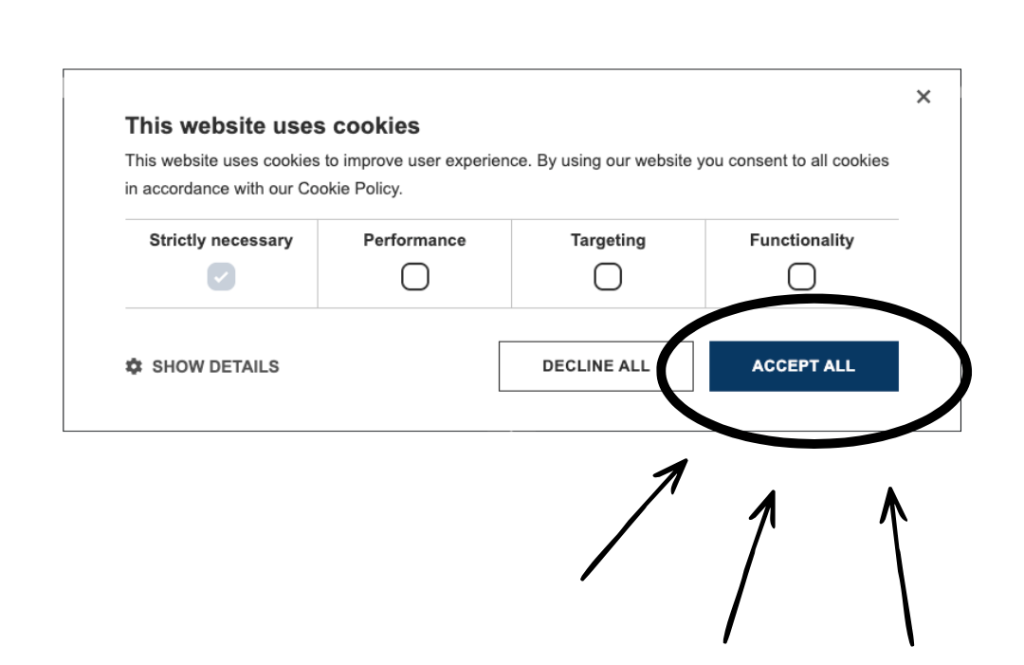
As you can see, we’ve highlighted the ‘Accept All’ button in a darker blue.
Both Decline All and Accept All are clearly available, giving users a straightforward choice. The Accept All button is visually stronger, which makes it stand out as the primary action.
External forces do affect people’s decisions
Not everyone approaches cookie consent in the same way.
Some people are happy to accept cookies and move on. Others are more cautious about how their data is used, especially when it comes to tracking, profiling and personalised advertising.
This matters because privacy expectations are changing. Younger users appear less likely to accept cookies, and people who care more about protecting their personal data are more likely to reject them.
For website owners, it’s a useful reminder that your cookie banner is being seen by people with different levels of trust, different attitudes towards data and different expectations of control.
A clear banner helps all of them make the choice that feels right.
Why this matters for your website
Cookie banners can be easy to overlook, but they play an important role in how your website works.
They affect what users consent to, what data can be collected, and how tools like Google Analytics and Google Ads receive information. If your banner is unclear, poorly configured or not connected properly, it can affect your tracking and reporting.
The design matters too.
Users should be able to understand their options and make a clear choice without feeling confused or pushed in one direction. That does not mean making the journey complicated. It means making it clear, balanced and easy to use.
For website owners and marketing teams, the key takeaway is simple.
Cookie consent is not just a compliance box to tick. It is part of your user experience, your data setup and your wider digital strategy.
Getting it right helps users feel more in control, and helps businesses collect consent in a way that supports clearer, more reliable reporting.
For a deeper look at how this works technically, we’ve put together a guide to Consent Mode version 2.
Not sure if your cookie banner is helping or hindering your tracking? Give us a shout, we’re happy to take a look.